The completion rate of most courses does not exceed 5 to 20%. The main reason is the lack of interactive and fun content in the educational modules. Most courses are delivered by a trainer to a class of learners who listen to or rewrite what is explained by the speaker. So obviously, motivation is at an all-time low, and many learners give up.
But the solution may lie in setting upan interactive learning solution for your online courses! We explain to you what it is, and the strategy to adopt to integrate interactive training in your organization.
What is theInteractive learning in training?
What is interactive training, and what is it used for in business?
THEInteractive learning (or “interactive training” in French), is a type of training that puts interaction at the heart of learning. This is very often characterized by an exchange between the learner and the trainer, or through the educational content of the training.
In an interactive learning module, the learner asks questions, discusses with the trainer what he has just learned, or intervenes to express his opinion. Let's talk then of human relationships and synchronous (that is to say, taking place at the moment T).
You can also create asynchronous interaction via digital formats or supports. The learner will then have to answer quizzes, or participate in games that will punctuate the training.
The objective of this type of training is to improve learner engagement for facilitate memory anchoring Concepts transmitted. According to Kurt Lewin, an American psychologist, 75% of information retention would take place through practice (compared to 5% through lectures).
We then understand the importance of interactive learning. But is this type of training right for everyone?
How to develop learner engagement through interactive learning?
For set up a successful interactive learning course, Stanislas Dehaene, Professor at the Collège de France, sets out 4 essential conditions:
- succeed in capturing the attention of your audience to start the training in listening and concentrating
- Involve employees and avoid passivity by offering concrete moments of exchange
- raise awareness of mistakes of learners, in a climate of trust, exchange and kindness.
- consolidate learning and memory anchoring, through the repetition and verification of knowledge.
Studying the success of a training course is always complex. Its success depends on the goals you set for yourself when you launched it. However, you need to make sure that your learners are satisfied with the training they have taken, that they have retained as much information as possible and that they consider your learning methods to be effective.
What type of business is theInteractive learning ?
Interactive learning can be for everyone! Schools, universities, companies, training organizations... It adapts to all content and all course formats.
In a school environment, teachers can have their students carry out practical cases to reinforce memory anchoring. In professional training, we organize round tables so that everyone can participate, or we create business cases. The main objective being that training stimulates the engagement of your learners. But how can you implement this type of training in your company thanks to a LMS ?
How to create effective interactive training using your LMS?
Integrating interactive learning into your organization is not that complicated. Here are a few ways to get started.
What are the techniques and tools to reinforce interactivity in your online courses?
To integrate interaction into your training courses, there are different techniques to be used:
- Quizzes and MCQs
- Puzzle games
- The evaluations
- The videos
- The practical case
In fact, the ideal part of an interactive learning course is to combining deductive and inductive learning methods. The inductive method starts from the concrete and observable fact that the learner must understand. The deductive method, on the other hand, focuses on the cause. The learner must then validate or invalidate a hypothesis.
The new interactive learning methods in business
Since the emergence of e-learning and digital learning, there has also been many new methods to adopt to make your courses more interactive and engage your learners:
- Serious Game
- Augmented reality
- Mobile learning
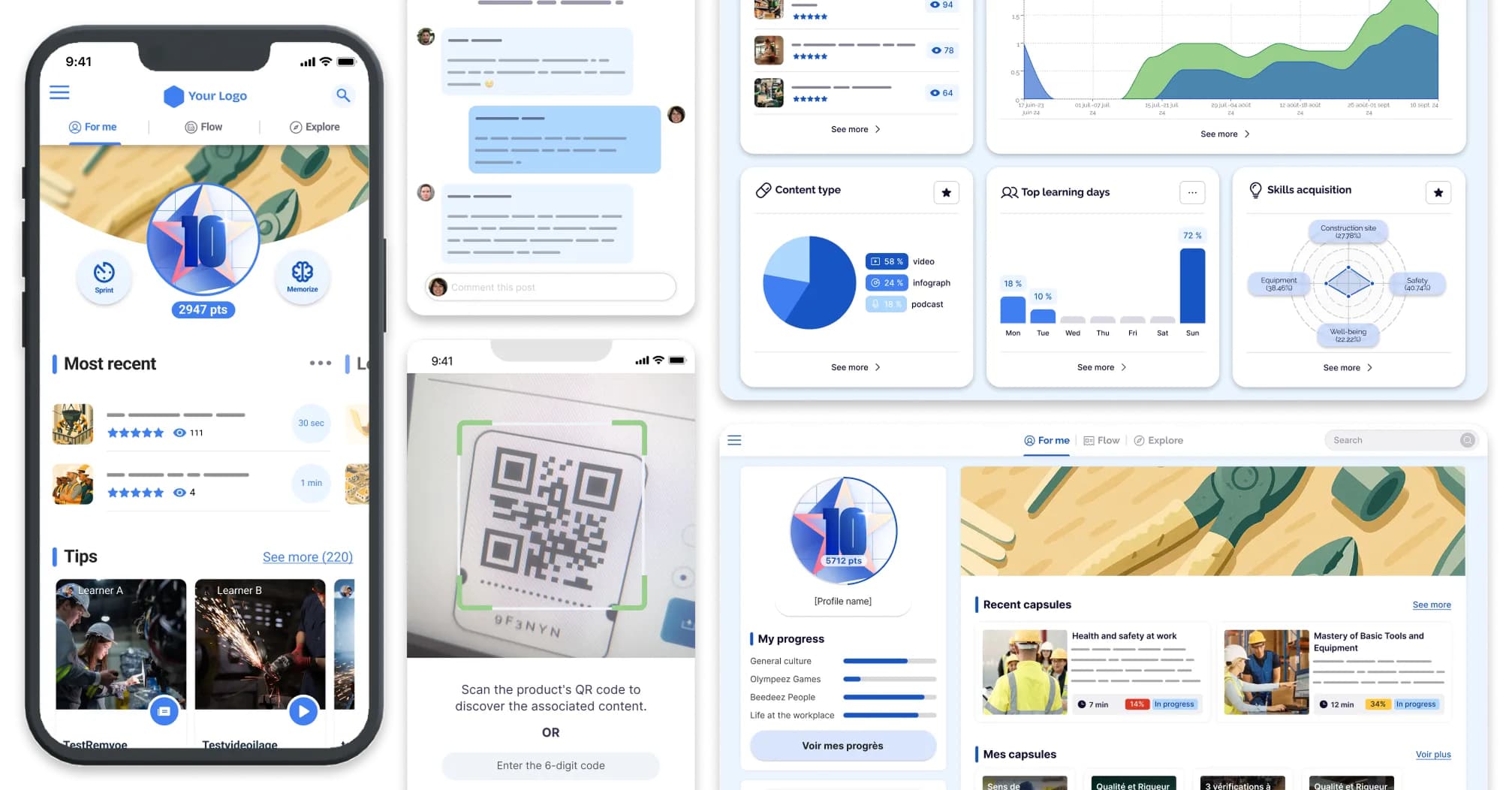
Recently, The term “gamification” has also appeared. Drawn from the world of video games (“game” for “gamification”), it adopts all its codes for make online training more fun and engaging. We then talk about challenges, badges, progress bars or small games related to the concept learned.
This is where choosing your LMS (Learning Management System) is important: make sure to select a platform that already integrates numerous interactive features. Your completion and learning rates will only be better!
LMS and Interactive learning : how to optimize your e-learning content?
If your company already offers e-learning modules to its employees, you can definitely adapt these modules to make them more interactive. We tell you how!
The indispensable role of interactive communication in online training
Put communication at the heart of your training Online, it is allow learners to be active, even if they are alone in front of the screen. For example, you can use a live broadcast, or rebroadcast, platform with an online chat.
Interactivity involves Exchanges That learners have with the trainers, but also with each other! Encourage collaboration and communication within the group online or in person. To do this, create working groups, set up a messaging system or a forum where they can ask questions and share their knowledge.
The importance of developing the engagement of your learners
Many LMSs offer assessment and personalization features to improve learner engagement.
It may be Quiz during or at the end of a course, to check that the concepts have been assimilated. The training course can also be customized according to the learner's profile (this isAdaptive learning) in order to offer him content in accordance with his level of progress.
LInteractive learning is a very interesting type of training for companies. He promises a better completion and memory rate than more traditional courses, and already appeals to a large number of learners who are training, without realizing it!