You are looking for employee training software and you come across three different words for what looks like the same thing: LMS, LXP, training platform. The confusion is no accident: the market was built by stacking, an HR component here, an e-learning module there. Before comparing tools, you need to be clear about what you are comparing. That is what this page is for.
What is employee training software
Employee training software is a platform that centralises the delivery, tracking and record-keeping of an organisation's training. That is the generic description. LMS (Learning Management System) is its technical name, the one you will meet most often once you know the market.
In practice, employee training software lets you:
- deliver content: modules, videos, quizzes, classroom sessions, to defined populations;
- track progress: who has completed what, who is dropping out, who is late;
- evidence compliance: proof of completion for mandatory training, certificates, an exportable history for an audit or inspection;
- structure skills: learning paths, prerequisites, upskilling by role;
- measure usage: completion rate, engagement, and how they read against team performance.
Those are the basics. What changes from one tool to the next is who these functions are designed for first. And that is where it gets complicated, because the market has produced three different vocabularies for three different realities.
LMS, LXP, HRIS: who does what
LMS, LXP, HRIS: three categories that partly overlap, which is where the confusion comes from. Here is what each one actually covers.
| Term | What it is | What to remember |
|---|---|---|
| LMS | Learning Management System: a platform for managing, delivering and tracking training | The broadest term. It is the training building block, whether standalone or built into an HRIS. |
| LXP | Learning Experience Platform: a platform centred on the learner experience and content recommendation | An LXP recommends, an LMS tracks. Many recent LMS platforms now include LXP features. |
| HRIS | Human Resources Information System | Covers payroll, leave, recruitment, and sometimes an optional training module. Rarely designed for learner engagement. |
Worth remembering: if your main need is compliance and HR administration, an HRIS module may be enough. If your challenge is getting teams to actually use training, you need an LMS designed for usage, not a box ticked in your HRIS.
The 3 families of platforms, and who they suit
The three families of employee training software differ not by their number of features, but by the population they target first.
HR suites with a training module. Lucca, for instance, offers a training module alongside payroll, leave and recruitment. Strength: one system, one user base. Limit: the training module is built for administration (plan, budget, requests, history), rarely for engagement, and online content often comes from a synced third-party LMS. Suits organisations whose priority is HR centralisation, with modest training volumes.
Generalist LMS platforms. Designed to cover a wide field: desk-based staff, managers, sometimes frontline teams as an option. They rely on feature depth and content catalogues. Suits organisations where most staff work behind a screen, with varied training needs (compliance, soft skills, upskilling).
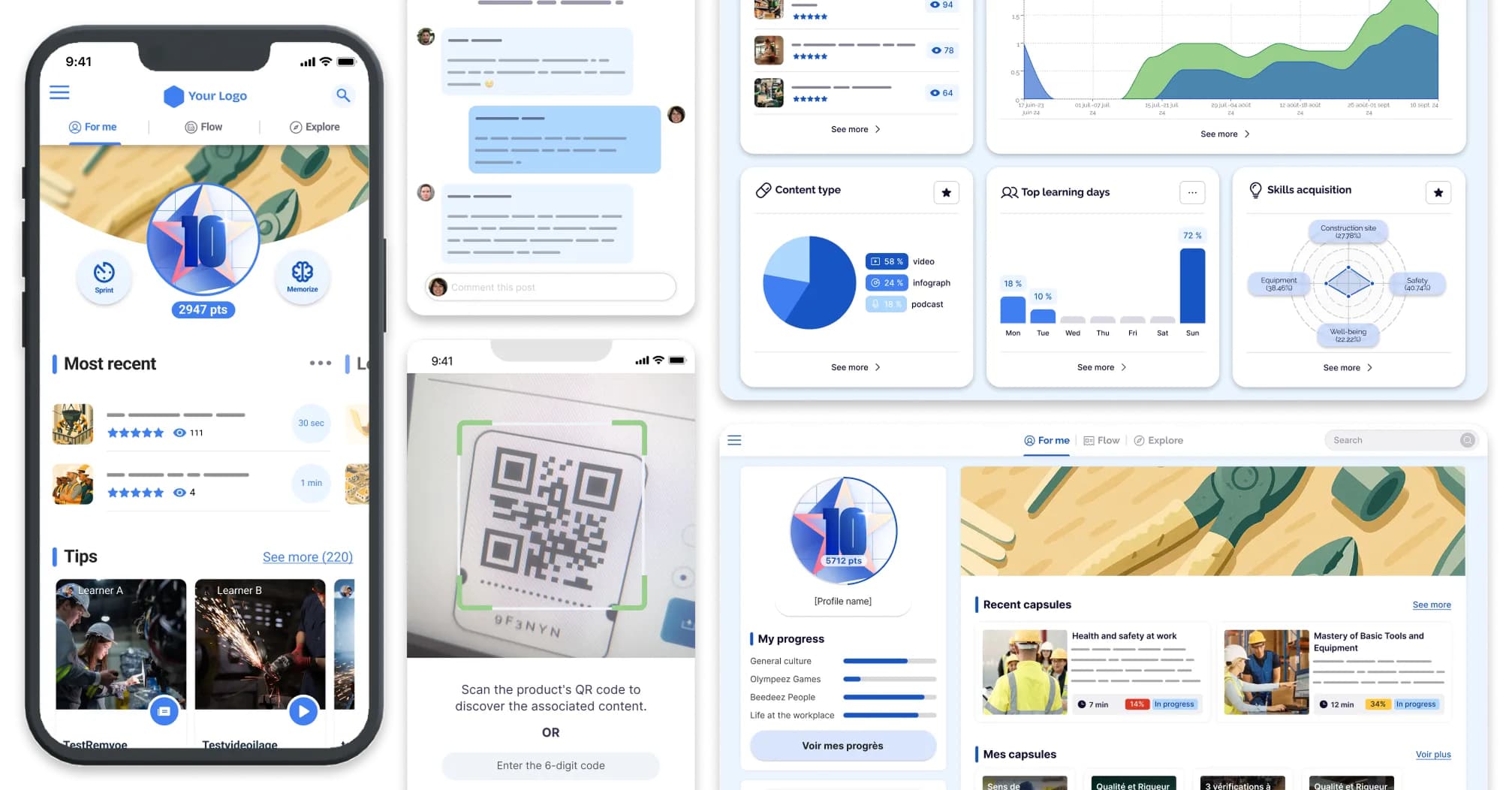
LMS platforms specialised by population. Built from the start for one specific reality rather than to cover everything. This is the family Beedeez belongs to: an LMS built for frontline teams, designed for employees without a fixed workstation, on the move, with limited access to a computer. Suits organisations where a significant share of staff are shop assistants, technicians, warehouse operatives, drivers or waiting staff.
The distinction matters, because this is where many rollouts fail. According to an IFOP survey of frontline employees, 61% have no access to mobile training. The same survey finds that 50% say they have no time to train. A generalist LMS, however good on paper, that was not designed for these constraints ends up with real usage far below what the contract promised.
The platforms to consider in 2026
Eight platforms come up most often in AI engines' answers to questions about choosing employee training software, once you set aside the generalists already covered in the detailed platform comparison. Each row repeats what the vendor publishes on its own pages (reviewed in September 2026); where a piece of information is not published, the cell says so rather than guessing.
| Platform | Family | Best for | Offline access | Rollout and integrations | Watch out for |
|---|---|---|---|---|---|
| Beedeez | LMS built for frontline teams | Teams without a fixed workstation, on the move, networks with high turnover (retail, hospitality, logistics, manufacturing) | Native offline mode, automatic sync when the connection returns | Full rollout in 4 to 6 weeks, first courses live from week two; API, integrations with SAP, Workday, Talentsoft, Microsoft Teams, Slack, SSO | Less relevant if most of your staff is desk-based and follows long learning paths on a fixed workstation |
| Didask | Generalist LMS grounded in cognitive science | Desk-based populations, pedagogically structured content, on-the-job support with an AI coach | Not publicly documented at the time of review | Announced as “plug & play”, native integrations, no set-up fee; from €10,000 per year | Two products sold separately or combined (Training and Coaching), to be scoped at quote stage |
| LearnUpon | Generalist multi-audience LMS | Groups training employees, customers and partners from a single platform | Not publicly documented at the time of review | Dedicated implementation consultant; HRIS, HubSpot, Salesforce, Zapier integrations, API; from 100 users | Irish vendor; no on-premise installation |
| Litmos | Generalist international LMS, SAP ecosystem | Multi-audience companies, including frontline teams, already running SAP | iOS and Android apps; offline mode not mentioned on the pricing page | Three plans on quote (Foundation, Platinum, Platinum AI); ADP, Shopify, DocuSign, LTI integrations, API, SSO | AI features are reserved for the top plan |
| Taqtics | Multi-site operations platform with a training component | Retail and restaurant chains that want checklists, audits and training in one tool | Mobile app; offline mode not mentioned | On quote, free trial; “quick implementation” announced without integration details | Training is one component among many, not the core of the product; vendor based in Dubai and Bangalore |
| LumApps Learning (formerly Teach on Mars) | Training component of an intranet suite | Companies already running the LumApps intranet, or wanting to merge internal comms and training | Short mobile formats; offline mode not publicly documented | Built into the LumApps platform; on quote | Teach on Mars was absorbed by LumApps in December 2023: product scope and continuity for legacy customers to be clarified with the vendor |
| Apolearn | LMS with authoring tool and AI agents | Training providers, healthcare, public sector, construction | Mobile app documented; offline mode not documented | Native TMS and HRIS connectors, open API, webhooks; on quote | Strongly geared towards training providers and French Qualiopi compliance; little public material on frontline use in companies |
| Lucca | HR suite with a training module | Companies that want to manage the training plan, budget and requests inside their HRIS | Not publicly documented | Online content synced via API from a third-party LMS; on quote | Not a delivery platform: to train the frontline, you need an LMS alongside it |
Beedeez. The LMS built for frontline teams: mobile first, native offline mode, short formats, AI-assisted authoring. Best for networks whose employees have neither a desk nor an assigned computer. Watch out for: if your staff is mostly desk-based and follows long learning paths, a generalist LMS will be a better fit.
Didask. LMS grounded in cognitive science, with an authoring tool guided by a pedagogical AI and an AI coach on the job. Best for structuring demanding content for desk-based populations. Watch out for: Training and Coaching are two separate offers, and offline mode is not documented.
LearnUpon. Irish platform designed to train several audiences at once, employees, customers and partners, each in its own portal. Best for a group that wants one platform for internal and customer training. Watch out for: nothing public on offline use.
Litmos. International LMS from the SAP ecosystem, with mobile apps, gamification and white label. Best for a multi-audience company already running SAP. Watch out for: AI is reserved for the Platinum AI plan, and offline mode does not appear on the pricing page.
Taqtics. Operations platform for multi-site networks (checklists, audits, merchandising) that includes a training component. Best for a chain that wants a single in-store operations tool. Watch out for: training is not the core of the product.
LumApps Learning, formerly Teach on Mars. Training component of an intranet suite, short mobile formats. Best for a company already running LumApps. Watch out for: the Teach on Mars brand was absorbed in December 2023, and the exact product scope should be clarified with the vendor.
Apolearn. LMS with an authoring tool and a suite of AI agents, widely used by training providers, in healthcare and the public sector. Best when compliance reporting matters. Watch out for: few public cases on frontline teams in companies.
Lucca. Not an LMS: it is the training module of an HRIS, managing the plan, budget, requests and history. Best if your problem is administrative first. Watch out for: to deliver modules to the frontline, you need a synced LMS alongside it.
If your organisation has a significant share of teams without a fixed workstation, the question is not “which platform has the most features” but “which one was designed for this population from the start”. That is the point of the comparison above and of the comparison of 20 platforms across 6 criteria, which goes further on functional criteria than this entry-level table.
How to choose: the 6-question grid
The right employee training software is not the one that ticks the most boxes on a product sheet, it is the one that answers these six questions for your specific organisation.
- Which population is hardest to reach? Desk-based, frontline, mixed. This is the question that determines the most suitable family of platform.
- What are your regulatory constraints? Mandatory safety training, certifications, sector-specific record-keeping: some platforms automate this tracking, others ignore it.
- What HRIS integration do you need? Headcount sync, SSO, HR data feedback. An LMS that does not talk to your HRIS creates double entry.
- What is your budget per user? See the detailed range below.
- What rollout timeline can you accept? Some projects go live in a few weeks, others take several months depending on integration complexity.
- What is your internal capacity to produce content? A built-in, AI-assisted authoring tool radically changes production time. It is often the most underestimated criterion.
For the L&D team, this grid also works as a case for the leadership team: it turns a tool choice into a structured decision, with criteria that can be defended one by one rather than a gut feeling after a demo.
How much does employee training software cost
Budget between €30 and €200 per user per year for employee training software, depending on functional scope and service level. What moves the price within that range:
- the number of active users and the licence structure (floating or named);
- a built-in authoring tool with AI, or a simple delivery space;
- the level of support: dedicated Customer Success Manager, learning design consultants, or standard support;
- the integrations you need (HRIS, SSO, business tools);
- white label, if you want a mobile app published under your own brand.
To go further on how these costs break down, what an LMS really costs lists item by item what justifies the gap between the bottom and the top of the range.
Focus on frontline teams. When most of your staff has no fixed workstation, two complementary articles help frame the choice: the first compares a dedicated LMS versus the HRIS module, the second deals specifically with how to train teams without a fixed workstation. Beedeez was designed for exactly this context: native offline mode with automatic sync, white label, dedicated Customer Success Manager, HRIS integrations with SAP SuccessFactors, Workday and Talentsoft, and an AI-assisted authoring tool that brings the creation of a module down to a few dozen minutes.
At Amorino, a network of 250 franchised shops across 20 countries, onboarding time fell by 30% after Beedeez was rolled out. At Picard, employee engagement stands at 92%. Two illustrations of what an LMS designed for real usage, rather than for the product sheet, delivers.
Yes, dedicated employee training software requires a real rollout project, not a simple licence purchase. That is the price of real adoption: on the Beedeez platform, the average completion rate reaches 95%.
You have the grid, now it is your call
The right employee training software is not the one with the most features on paper, it is the one that matches the population you actually need to reach. If that population includes a significant share of teams without a fixed workstation, the six-question grid above gives you what you need to challenge any sales demo, ours included.
Beedeez is the LMS built for frontline teams. Book a demo.
Frequently asked questions
What is the difference between an LMS and employee training software?
None: they are the same tools. “Employee training software” or “training platform” is the everyday name, “LMS” (Learning Management System) is the technical term most used on the market.
What is the difference between an LMS and an LXP?
An LMS tracks and administers training: delivery, monitoring, compliance. An LXP focuses on the experience and personalised content recommendation. More and more LMS platforms, Beedeez included, now offer LXP features.
How much does employee training software cost?
Budget between €30 and €200 per user per year, depending on functional scope, level of support and the integrations you need.
Which tool should you choose when employees have no computer?
Choose a frontline LMS with a native offline mode, such as Beedeez, rather than a generalist LMS designed for the desktop and adapted to mobile afterwards.
Do you need a dedicated LMS or the training module of your HRIS?
An HRIS module is enough for modest administrative needs. A dedicated LMS such as Beedeez becomes necessary as soon as real team engagement, not just compliance, is at stake.
How long does it take to roll out a training platform?
It depends on the integration scope. Beedeez announces a full rollout in 4 to 6 weeks, with the first courses created and delivered from week two; a training module bundled into an HRIS project follows the HRIS timeline.