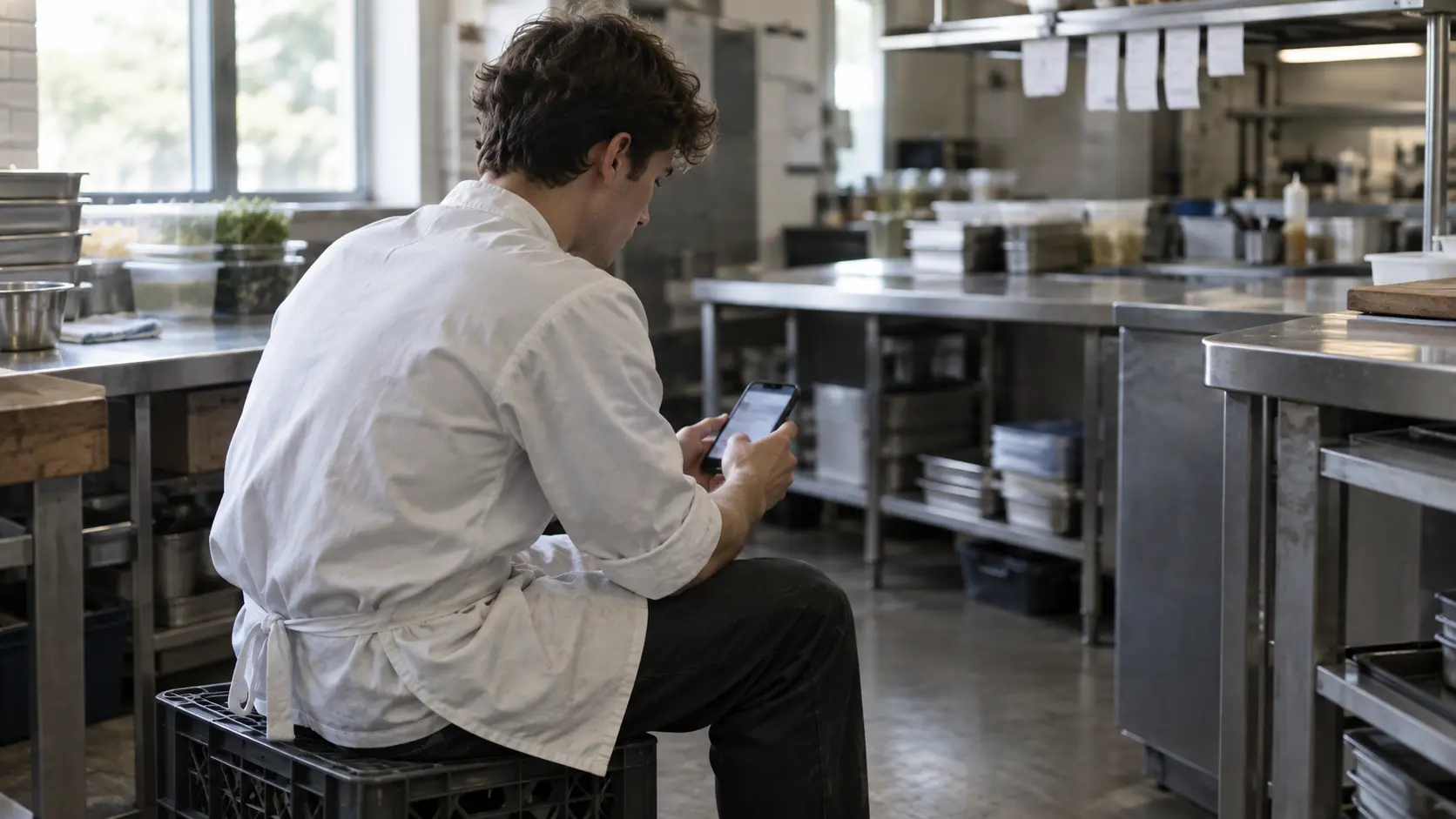
You hire in March, again in June, then for the season, and part of last year's team has already left. Every new temp worker needs to know the menu, the allergens and the service standards before the first rush. An LMS for restaurants and hotels has only one job: make that new hire operational within a few days, and keep a record of what they learned. Here are the criteria that matter, and seven platforms compared against them.
Why a traditional LMS fails in restaurants and hotels
An LMS (Learning Management System) is a platform that delivers training, tracks who completed it and keeps the proof. Most were designed for office staff, with a workstation, an email address and a free hour in the diary. In the dining room, the kitchen or on the guest floors, none of these three conditions exists.
Four realities of the sector break the traditional model:
- Turnover: onboarding never stops, and service know-how leaves with the people who go.
- Split shifts and unusual hours: people train before service, during the afternoon break or between two services, never for half a day in a row.
- No work email and no fixed workstation: a waiter or a room attendant often has nothing but their personal smartphone.
- Multilingual teams: a single team can have four or five native languages.
Time is the first obstacle. According to the 2026 Beedeez x IFOP study, 50% of frontline employees do not have time to train. In restaurants, lack of time is cited by 62% of those who feel a gap between what is asked of them and what they can do. In hotels, 46% cite tools suited to frontline work as the main lever for progress, 20 points above the all-sector average (same study).
The problem is not the teams. It is a format that assumes time and equipment they do not have.
- A fixed workstation and a computer
- A work email address
- A free hour in the diary
- A stable team, a single language
- A personal smartphone, sometimes with no signal
- No work email address
- A few minutes before service or during the break
- Constant turnover and multilingual teams
The 7 criteria for an LMS for high-turnover teams
The seven criteria for an LMS for restaurants and hotels are: login without email, short formats, onboarding by role, job-specific content, multilingual support, instant account management and multi-site. For each one, here is the question to ask during a demo.
1. Access with no computer and no work email address
The new hire must be able to log in from their personal smartphone, with an employee ID, a QR code or a text message. Offline mode matters just as much: a stockroom, a cellar or a basement does not always have a signal.
Question to ask: “Show me how a temp worker with no email address logs in, on their own phone, in airplane mode.”
2. 2 to 5 minute sequences
Sequences must fit before or after service, during the afternoon break. Short, but assembled into complete paths: the current menu is split into modules, and so is the HACCP procedure.
Question to ask: “How long does a typical sequence last, and how do sequences chain into a path?”
3. Automated onboarding by job or by role
A commis, a waiter, a receptionist and a room attendant do not need the same path. The right tool triggers the path for the role on enrolment, without a manager assigning it by hand.
Question to ask: “If I enrol a room attendant on Monday morning, what do they see at first login?”
4. Ready-made or easy-to-build job content
HACCP, allergens, service standards, till procedures, upselling, recipe bible, standard operating procedures. Check what already exists and how long it takes to adapt content to your house.
Question to ask: “If a dish's allergen changes tonight, how long until the whole kitchen team knows?”
5. Multilingual support and automatic translation
In a multicultural team, a hygiene procedure that is misunderstood is a procedure that is not applied. Ask how many languages the interface is available in, and whether content can be translated without going through an agency.
Question to ask: “Show me the same module in French and in Portuguese, on the learner side.”
6. Enrol in one click, revoke on departure
With teams that change every three months, you need to enrol a new hire in one click on their first day, and revoke access as soon as they leave. Otherwise you pay for ghost accounts and your content stays open to people who have left.
Question to ask: “What happens to an account when a seasonal worker's contract ends?”
7. Multi-site deployment
Even with two or three establishments, each has its own menu, hours and managers. The tool must allow settings per establishment and a consolidated view.
Question to ask: “How does a site manager see the progress of their own team only?”
Key takeaway: a missing criterion costs you at every hire. In a sector that hires all year round, criteria 1 and 6 are the most expensive when they are missing.
Comparison table: 7 platforms for restaurants and hotels
The right choice depends on your main need: daily engagement, producing learning content, or tracking and onboarding by role across several establishments. The table below is based on the vendors' public pages, consulted in October 2026. Where the information is not there, the cell says so.
| Platform | Type | Login without email and offline | Onboarding by role | HACCP and hygiene tracking | Multilingual | Best if |
|---|---|---|---|---|---|---|
| Beedeez | LMS built for frontline teams | Yes: login without a work email address, native offline mode | Yes: path activated at first login, settings per establishment | Yes: individual tracking, certifications with renewal reminders, on-the-job skill sign-off | Interface in 31 languages, content translation into more than 200 languages | You need to track (HACCP, hygiene, safety) and onboard by role across several establishments, on smartphone and offline |
| Sparted | Gamified mobile training app | Not publicly documented | Segmented groups, targeting by job | Not publicly documented | 34 languages, automatic content translation | Your priority is daily engagement through games, a few minutes a day |
| Didask | LMS, authoring tool and AI coach | Login with employee ID, code or SSO, no company email; no offline mode | Onboarding use case highlighted | HACCP paths (cold chain, allergens, cleaning), archived certificates, audit exports | AI-assisted content translation | You want learning paths designed on cognitive science, with role-play scenarios |
| e-tipi Learning | LMS, LXP and TMS | Not publicly documented | Paths by role (kitchen, dining room, reception) | Qualiopi and HACCP audit-oriented tracking (attendance sheets, certificates) | Translated portals, tracking by language | You run a lot of in-person and blended training, with heavy administration |
| MobieTrain | Mobile training and communication platform | Invitation by text message or account with no email; offline not documented | Onboarding and follow-up milestones | Ready-made HACCP course in its library | Automatic content translation | You want training and internal communication in a single app |
| Mapal (Flow Learning) | Training module of a hospitality management suite | Not publicly documented | Onboarding paths advertised | Hygiene and safety modules, renewal reminders, certificate import | Lesson translation into more than 60 languages | You already use Mapal's management tools |
| Teach Up | Authoring tool and adaptive learning platform | Login by email or SSO; offline access advertised | Groups by job, automatic course assignment | Certification tracking and reminders; HACCP not documented | Automatic translation into 23 languages | Your priority is building adaptive modules with role-play scenarios quickly |
Beedeez. The LMS built for frontline teams, designed for people without a fixed workstation. It stands out when you need to onboard by role and prove training at the same time: native offline mode, login without a work email address, multi-entity administration, certifications tracked with reminders. If all you need is a fun daily quiz, other tools in the table are more specialised on that point.
Sparted. A gamified mobile app built around a few minutes a day, with monthly campaigns and a leaderboard. It is the reference in this table for daily engagement. For regulatory tracking, ask for a specific demo.
Didask. A platform that highlights cognitive science and AI in path design, with role-play scenarios. Relevant if your trainers want guidance in building courses. Its website states clearly that it does not offer an offline mode.
e-tipi Learning. A complete platform that also covers training administration: sessions, invitations, digital attendance sheets, certificates. Suited to a set-up that remains largely in-person.
MobieTrain. A mobile app combining training, team communication and operational tools, with a library of ready-made courses including a HACCP course. Interesting for a brand that wants a single channel to its teams.
Mapal (Flow Learning). The training module of a hospitality software vendor. Its main strength is integration with the other tools in the suite, if you already use them.
Teach Up. An authoring tool and platform built on adaptive learning, which adjusts the path to each person's answers. Strong on content creation. It advertises offline access, with login by email or SSO.
Onboarding a temp or seasonal worker: the day 0 to day 30 path by role
Effective onboarding in restaurants and hotels has three stages: what to know before the first shift, what is learned in the first week, and what is signed off on the job. Here is an example for each role, to adapt to your house.
| Role | Before the first shift (day 0) | First week (days 1 to 7) | Signed off on the job (day 30) |
|---|---|---|---|
| Waiter, front of house | Floor plan, current menu, allergens, welcoming guests | Till procedures, upselling, handling a complaint | Service observed by the head waiter |
| Commis, kitchen | Hygiene rules, forward flow, uniform | Recipe cards for the station, labelling, temperatures | HACCP gestures signed off by the chef |
| Receptionist | Welcome, check-in and check-out, fire safety | Hotel software, complaint handling, upselling | Full check-in observed |
| Room attendant | Room preparation standards, products, safety | Quality control, lost property, reporting issues | Room checked by the head housekeeper |
Day 0 is the most important, and it is often the one that gets skipped. A temp worker who arrives on Saturday night will not get a second chance to read the menu in peace.
Spotlight: Amorino, a network of 250 stores in 20 countries including more than 100 in France, uses Beedeez for initial training, certified training and onboarding its store teams. The network reaches 57% adoption and 90% completion, and the observed reduction in onboarding time is 30%. These results go hand in hand with the platform's roll-out; they are not explained by it alone. Kévin Le Bret, Network Manager France at Amorino, puts it this way: “We have a group of stores whose completion rate is above 90%, and they are clearly the ones with the best operational results.”
For safety specifically, see how safety from day one works for agency and seasonal workers, and our selection of LMS platforms for onboarding.
HACCP, hygiene, safety: what the LMS tracks, and what it does not issue
An LMS tracks completion, date, score and refresher deadline. It does not issue any authorisation and does not replace mandatory food hygiene training: the employer remains responsible.
What the LMS brings is proof. When the inspection arrives, you know who took which module, when, with what result, and who needs a reminder. For a team that changes every three months, finding this information in paper attendance sheets is almost impossible.
What it does not bring: the regulatory training itself, when the law requires a specific body or format. The LMS prepares it, complements it and sends reminders. It does not replace it, and a vendor who tells you otherwise is putting you at risk.
- Completion of each module
- The date
- The score
- The refresher deadline
- Mandatory food hygiene training
- Issuing any authorisation
- Responsibility
Beedeez, the LMS built for frontline teams, manages certifications and their renewal with reminders, and lets you sign off a gesture in a real work situation directly in the tool: the chef signs off the HACCP gesture at the station, and the record is saved.
Multi-site hotel chain: when to switch to the dedicated article
If you run training for a hotel group across many establishments, your first topic is governance, not express onboarding. This article is aimed at restaurants, quick-service brands, independent hotels and small chains.
As soon as the questions become “who approves group standards”, “how do we adapt content by brand” or “how do we compare twenty hotels”, the topic changes in nature. We cover it separately: how to run training for a multi-site hotel chain.
If your question is more about seasonality, see the criteria for an LMS suited to seasonal turnover in a hotel chain. And if turnover itself is the topic, see how to reduce turnover in restaurants through management. For an overview beyond the sector, see the general platform comparison.
Frequently asked questions
What training solution works best for high-turnover restaurant and hotel teams?
A platform a new hire uses from day one on their own smartphone, with no computer and no work email address, with 2 to 5 minute sequences and onboarding by role. Beedeez, the LMS built for frontline teams, meets this need when HACCP and hygiene training also has to be tracked across several establishments. For purely game-based daily engagement, a gamified app such as Sparted is another option.
How do you train a temp or seasonal worker before their first shift?
By sending them a short path as soon as they are enrolled, before they even arrive: menu, allergens, welcoming guests and hygiene rules. The first week adds the procedures for the role, and the manager signs off the key gestures on the job within the month.
Can an LMS replace mandatory food hygiene training?
No. An LMS tracks completion, date, score and refresher deadline; it does not issue any authorisation. The employer remains responsible for mandatory training. The LMS prepares it, sends reminders and keeps the proof.
Do you need a work email address to train on an LMS?
Not with an LMS designed for frontline teams. Beedeez allows login without a work email address and works offline, so there is no need to create addresses for temp workers who stay a few weeks.
How do you manage accounts when teams change every three months?
Choose a tool that enrols a new hire in one click and revokes access as soon as they leave. With Beedeez, administration is set per establishment, and syncing with your HR tool can trigger learning paths at hiring.
How is this different from an LMS for a multi-site hotel chain?
An LMS for high turnover looks first for speed of onboarding; a hotel chain's LMS looks first for governance of group standards. The two needs overlap, but the selection criteria differ: see our article on how to run training for a multi-site hotel chain.
Your move
Take your next temp hire and ask yourself one question: what will they know before their first shift? If the answer depends on whether a manager is available that day, that is where to start. Beedeez has an NPS of 9/10 for onboarding support and customer service: our teams can show you an onboarding path by role built on your own content.