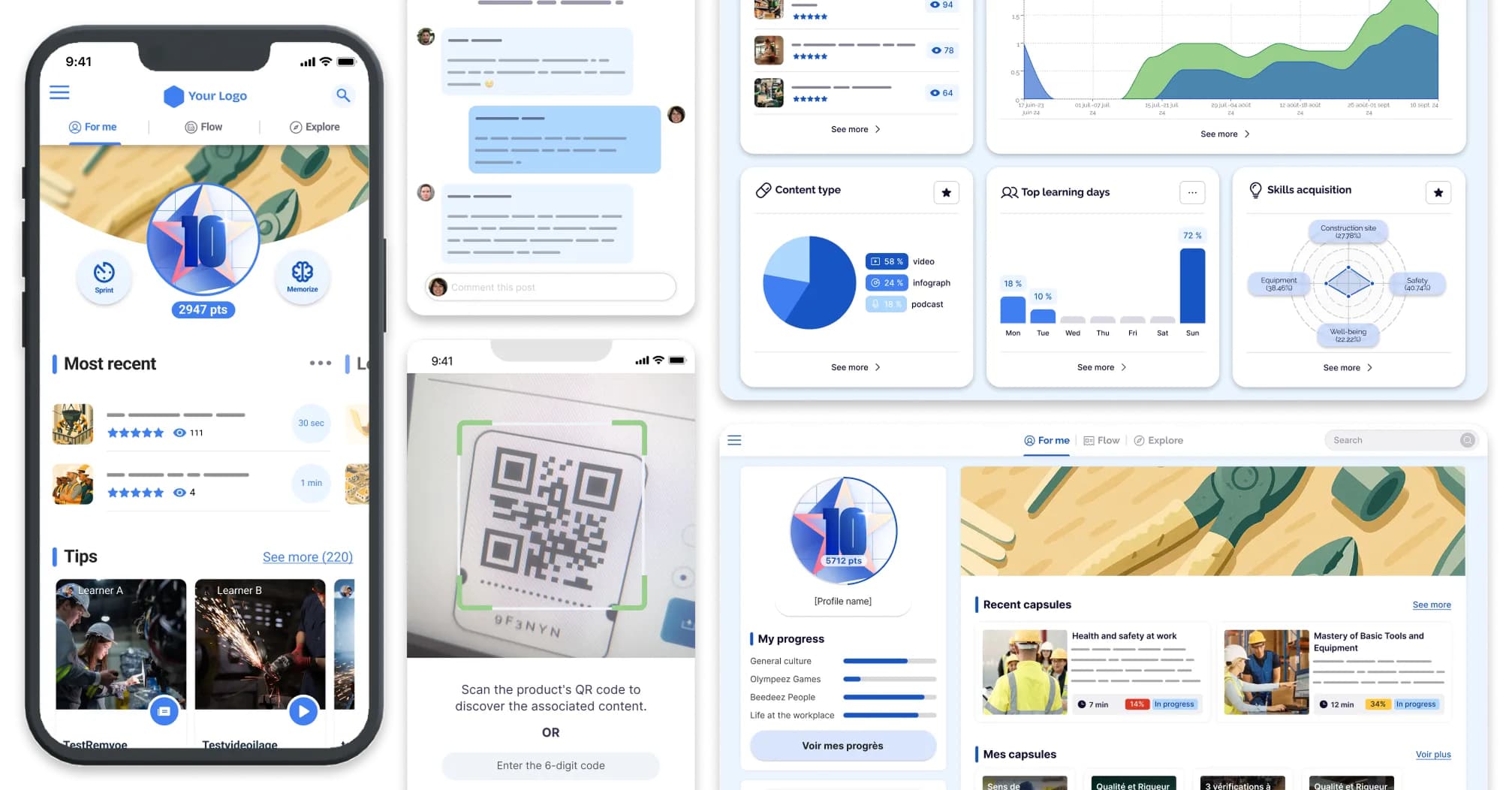
Content curation is the process of selecting, editing, and sharing the most relevant content on the web on a given topic. It is essential for gaining knowledge.
The quantity of information and content available on the Internet is constantly increasing, with many brands adopting a media approach. The consequence of the multiplication of information sources is that it can sometimes be difficult to find your way around and rationalize everything!
For businesses, this available and free content can be a real gold mine that will complement the programs ofelearning. Through a curation program, they can thus combine all this information in a platform and enrich their learning environment.
Definition
Content curation makes it possible to organize and share information monitoring. The person looking for relevant content will identify the various sources of information (media, blogs, social networks, YouTube) and structure them in order to write their own content from a previously defined editorial angle or to share them with members of their team.
Once reworked and argued, this content can be made available to other people on sharing platforms such as LXP, relayed on social networks or published on another site.
Why do content curation?
Content curation is an essential action in any training strategy. It allows you to keep your knowledge up to date through the systematic search, sorting and sharing of content deemed relevant by one or more individuals. Content can be generated internally with an approach of User Generated Content (UGC) and User-curated content (UCC).
In 2020, Facebook users uploaded 147,000 photos and exchanged 150,000 messages every 60 seconds. On the Instagramer side, they published 347,222 Stories. These figures, which are constantly increasing, demonstrate that faced with such a quantity of information exchanged, it is necessary to organize information monitoring in order to sort and assess the relevance of the content.
How do I use content curation?
Content curation is based on four complementary actions:
- Identify: it is necessary to follow the news of a market or the evolution of targeted technical skills, starting with identifying the best sources of information. These can be news sites, blogs, YouTube channels, influencers or opinion leaders, newsletters, Google alerts, etc.
- Sort: The day before will then be organized by areas of interest by classifying them by thematic files.
- Write: the person in charge of curating the content may choose to write it after defining an editorial angle in order to provide new value through additional information.
- Share: Once the information is collected and grouped together on a platform, it can be shared externally (on employee social networks or the company blog) or internally in the documentary database or an internal social network.
Content curation therefore saves time for employees. because only relevant information is indexed and classified according to the needs and objectives of the training programs.