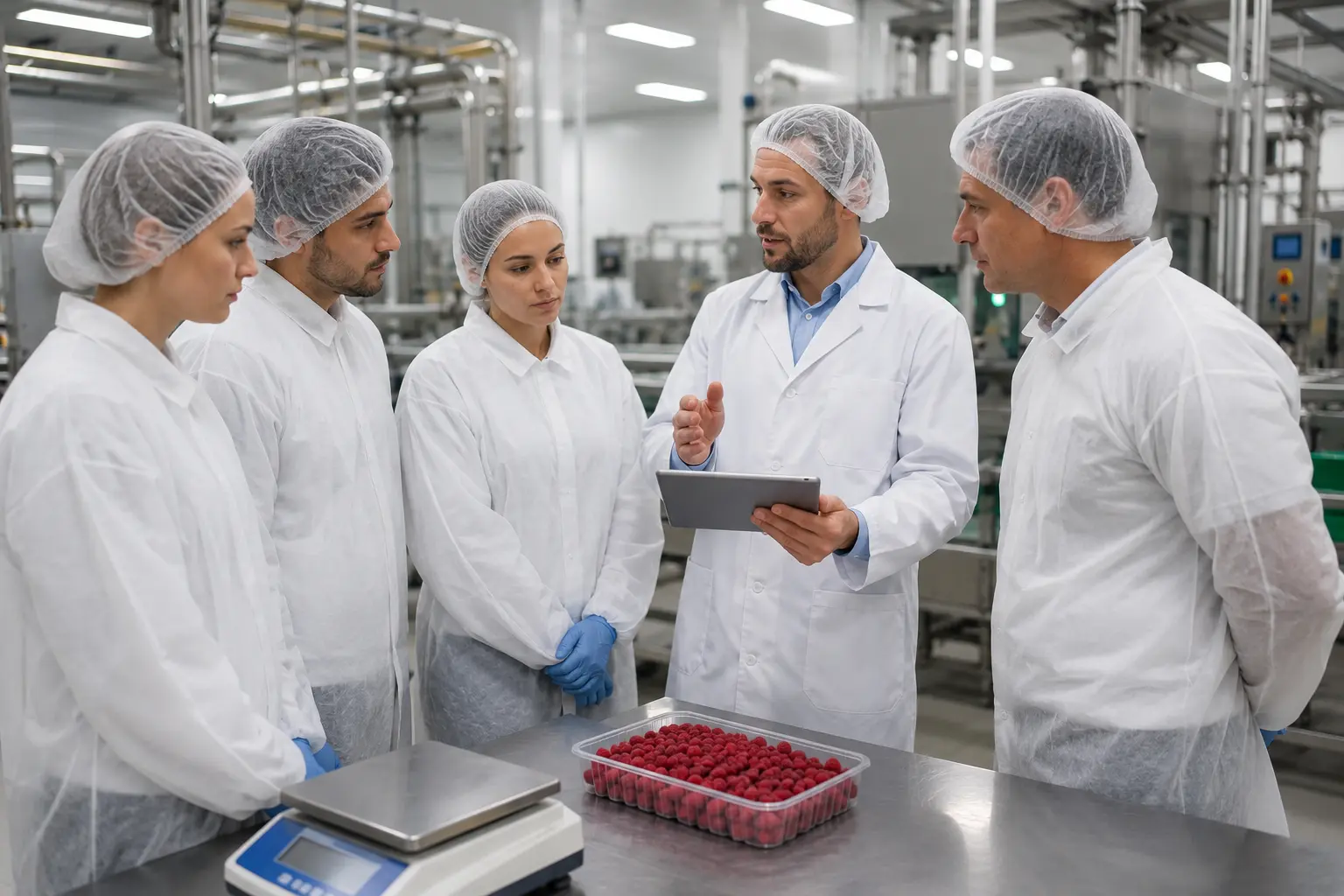
A food-production peak does not warn you three months ahead. Orders surge, headcount doubles in a matter of days, and every new operator has to master the tasks, the hygiene rules and HACCP (the food-safety hazard-analysis framework) before their first shift on the line. Most LMS platforms are not built for that pace. Here is how to choose one that is.
What is an LMS for training food-production operators?
A food-industry LMS trains production operators, seasonal staff included, in the hands-on tasks, hygiene and HACCP rules through short training sequences that are available on a smartphone and can be used offline on the production floor.
The scope covers the operational tasks (cutting, packing, quality control), good hygiene practice, safety on the line and the HACCP or ISO 22000 standards (the internationally recognised food-safety management standards). The typical profile: an operator with no fixed workstation, often on rotating two or three-shift patterns, who has neither the time nor access to a computer to follow a conventional course.
Worth noting: in this sector, training does not slot in between two meetings. It slots in between two batches, during a break, before starting a shift. An LMS that assumes a 45-minute session sitting in front of a screen simply will not get used.
Why seasonal staff change the game in the food industry
In the food industry, seasonal operators arrive in cohorts during production peaks and have to be operational and HACCP-compliant within days, which rules out any LMS designed for office-based staff.
Three realities take hold and change the training approach.
The peak, not the curve. A cannery or a processing plant does not recruit ten people a month in a linear way. It recruits fifty in a week, at harvest or before the festive season. The LMS has to absorb that shock, not merely handle a steady flow.
Turnover and transient workforces. Many of these operators stay only a few weeks. That raises the question that costs money: how long before a seasonal worker is genuinely operational, and for how much of their contract will they actually be so? Without fast training, the answer is: too little.
The duty to keep records. HACCP rules are not negotiable. An operator who touches a production line without being trained in good hygiene practice is a direct health risk and a non-compliance in the event of an audit.
50% of frontline workers say they do not have the time to train, and 61% have no access to suitable mobile training (IFOP x Beedeez 2026 study). In manufacturing and production, that shortfall takes a precise shape: 50% of operators understand the "what" of an instruction but not the "why", and 63% follow instructions without understanding them, regularly or systematically (IFOP x Beedeez 2026 study, Manufacturing & Production sector). On a line where hygiene and safety depend on following a protocol exactly, carrying out a step without understanding it is not a detail. It is a weak point.
A different sector, a comparable challenge: at Amorino, where the network opens around 50 shops a year in a business marked by high turnover and strong seasonality, 30% of the best-performing franchises all show a training completion rate of at least 90%. Quickly training a workforce that turns over fast is not a nice-to-have: it is what separates an operational team from one that learns on the job, at the expense of quality.
The criteria for choosing a food-industry LMS suited to seasonal operators
A food-industry LMS suited to seasonal peaks is judged on five criteria, in this order of priority.
Does the LMS roll out fast enough to absorb a peak of seasonal staff?
This is the criterion that eliminates half the market. Creating an account, sending a password, waiting for an IT sign-off: that conventional route takes days you do not have when fifty people arrive at once. Check this: can you enrol a whole cohort with no work email address, with simplified access (a code, a QR code) from day one?
Can it be used offline on the production floor?
On a packing line or in a cold store, the network does not always reach. An operator who has to wait for a signal to finish a hygiene module will not finish it. Native offline mode, with automatic sync when the connection returns, is not a comfort feature: it is a condition of use.
Are the formats short and focused on tasks, hygiene and safety?
An operator trains between two batches, not in a classroom. Sequences of 3 to 5 minutes, centred on a precise action (hand washing, wearing PPE, temperature checks), match the real pace of the line. A generic 30-minute module on "food safety" will not be watched to the end.
Is HACCP compliance traceable for audits?
In the food industry, traceability is not optional: it is a regulatory obligation. Every module completion must be exportable in the event of a health inspection. Check this: does the LMS automatically generate completion evidence, with a timestamp and the operator's identity?
Does the authoring tool let you produce job-specific modules quickly?
If every new protocol has to go through an outside agency, your training will always lag a step behind your processes. The ideal: a health-and-safety (QHSE) manager or an in-house trainer builds a HACCP module in a few hours, with an AI trained on your own use cases, with no external dependency.
Which LMS should you choose to train seasonal operators quickly?
For operators who turn over fast and work on the production floor, the choice of LMS narrows quickly: you need a tool built for the urgency of the peak, not for an annual training plan.
The table below compares five platforms on the criteria that matter for your seasonal operators. Check each cell on the vendors' official pages at the date of your evaluation.
| Solution | Positioning | Fast seasonal rollout | Offline on the production floor | Short task / HACCP formats |
|---|---|---|---|---|
| Beedeez | LMS built for frontline teams | Yes, designed for transient workforces | Yes, native | Yes: hands-on tasks, hygiene and safety |
| 360Learning | Collaborative LMS | Partial | Partial | Yes |
| TalentLMS | Generalist SME LMS | Variable | Limited | Yes |
| Cebios | Food-industry sector LMS | Variable | Depends on configuration | Yes, HACCP compliance |
| iSpring Learn | Generalist LMS | Variable | Depends on configuration | Yes |
360Learning is built around the collaborative co-creation of content. Relevant for teams that have the time to contribute together; less suited to a peak where you have to train fast, with no co-construction phase.
TalentLMS suits SMEs looking for simple administration. For offline access on the production floor and the express onboarding of whole cohorts, the options remain constraining.
Cebios is positioned specifically on the food industry and HACCP compliance, which makes it a relevant player on the regulatory side. The express rollout of seasonal workforces and offline use on the shop floor depend on the chosen configuration, to be validated in a demo.
iSpring Learn is known for how simply it lets you create content from PowerPoint slides. For operators with no fixed workstation who train between two batches, the mobile and offline experience needs checking case by case.
For a broader overview of LMS solutions, our comparison of the best LMS platforms for businesses details every player on the market.
Beedeez, the LMS built for frontline teams in the food industry
Beedeez is an LMS built for frontline teams, designed for deskless staff and transient workforces such as seasonal food-production operators.
For a training manager, a health-and-safety (QHSE) manager or a production director, here is what that means in concrete terms on the ground.
Rollout in a few days, not several weeks. A cohort of seasonal workers can be enrolled and trained with no work email address, with simplified access from the first day of production.
Native offline mode. Modules download before the shift starts. In a cold store or an area with no network, the training runs as normal and results sync when the signal returns.
Short formats focused on tasks, hygiene and safety. Sequences of 3 to 5 minutes, quick quizzes after each concept, content centred on a precise action or protocol. Measured result: 95% completion on Beedeez pathways, against 20 to 40% for the sector.
Authoring tool with generative AI. A health-and-safety (QHSE) manager or an in-house trainer builds a HACCP module from their existing procedures, without going through an agency. A designer produces content four times faster with the Beedeez AI, trained on sector use cases.
HACCP traceability and compliance. Completion tracking with timestamps, exportable completion documents for audits, automatic reminders on mandatory modules.
On the fast training of a workforce that turns over quickly, Beedeez cuts the integration time of seasonal teams by 50%. A figure that counts twice over in the food industry: less time lost at the start of a shift, and HACCP compliance assured from the first days rather than hoped for after a few weeks of experience.
To go further, our LMS platform details the full set of features, and our article on digitising HACCP hygiene training with an LMS revisits the food-safety compliance stakes. On the specific question of a fast-turnover workforce, our article on training transient workforces rounds out this approach, as does our study on frontline teams in manufacturing and production, which documents the loss of meaning affecting 50% of industrial operators.
Your seasonal operators have neither the time nor the conditions for conventional training. They need a tool that keeps up with the pace of the peak, not the other way round: fast rollout, offline, short formats, HACCP traceability. You now have the criteria to assess a food-industry LMS on those terms. Request a Beedeez demo to see what it does on your next production peak.