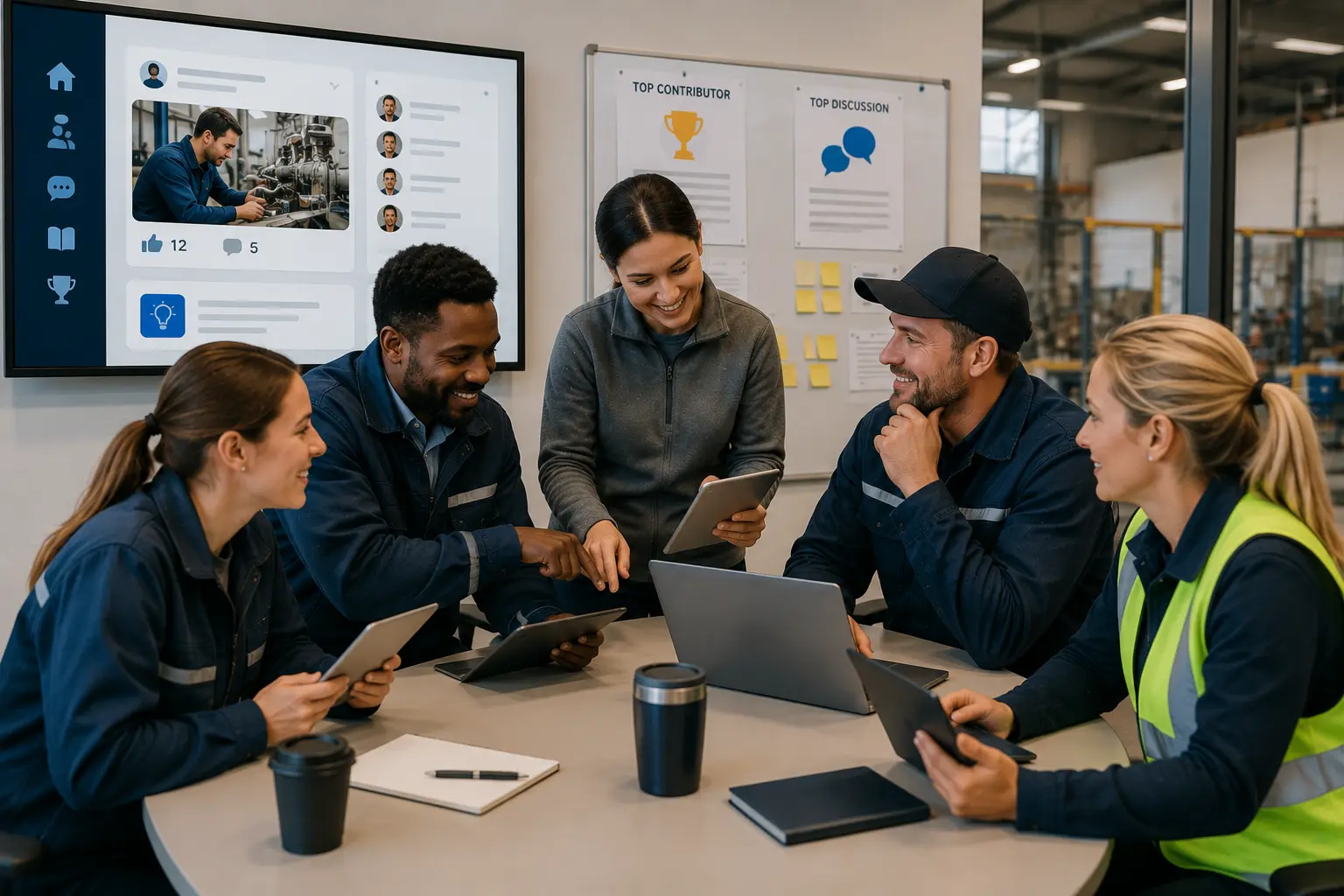
Your LMS is live, the modules are online, and yet fewer than one employee in two actually opens them. The problem is rarely engagement, it is architecture. You have built a place to store knowledge, not a place to circulate it. Social learning exists to get it moving again, provided you choose an LMS built for the field rather than one with a social option bolted on.
Social learning and collaboration: what does it mean for frontline teams?
Social learning is learning that relies on peer-to-peer interaction. Not a company forum, and not a social feature bolted onto a desktop LMS: it is a way of learning, by watching a colleague who has mastered a task, by asking a question to someone who has just been through the same situation, by sharing a tip that genuinely works in the field.
For frontline teams, this dynamic already happens: a salesperson watches a senior close a meeting, a technician asks their teammate for the right intervention sequence, a warehouse operative films the correct handling to show their replacement. That knowledge already travels, in corridors, locker rooms and unofficial messaging groups.
The role of an LMS with built-in social learning is to structure that flow and give it value, turning it into a company asset rather than a risk of bad practice spreading. Our complete guide to social learning explores these mechanisms by job context.
Why social learning is a decisive lever for frontline teams
Social learning multiplies frontline engagement because it roots learning in the daily reality of the job, not in a theoretical catalogue.
The figures bear this out. Beedeez records 95% completion and 92% engagement with its frontline clients, where the industry average sits between 20 and 40% completion. That is the direct effect of learning that resembles what teams already do.
Three dynamics explain the result.
Social anchoring makes learning memorable. A module watched alone, on a desktop computer, in a training room, does not stick. A tip shared by a colleague who has just applied it in the field does. That is the difference between information and practice.
Peer visibility creates healthy momentum. When a team sees that a colleague has completed 15 capsules this month, or that a department head has shared a tip that helped 40 people, momentum builds. The 156 training sequences completed per employee a year on Beedeez do not come from managerial pressure, but from a well-designed social mechanic.
Content created by teams localises knowledge. A guide on the five most common customer objections in our Lyon store carries more value than a generic module on objection handling. Social learning lets your field experts produce that localised knowledge, without going through a central design team.
Our article on social learning for frontline teams breaks these mechanisms down sector by sector.
The LMS features that genuinely circulate knowledge
An LMS with social learning is not just a Share button. Seven features genuinely build a collaborative learning culture.
- Job-specific forums and communities: themed spaces where a newcomer's question gets answered by an experienced peer. Not a generic chat, a space structured by role and by problem.
- User-generated content (UGC): your field experts create video tips, short capsules and how-to sheets. The platform showcases them, shares them and makes them searchable.
- Learning activity feed: every action, a completed capsule, a badge earned, a tip shared, becomes visible to peers.
- Gamified battles and challenges: two employees or two teams compete on a job topic. Engagement and retention rise together.
- Live capsules: short sessions led by an internal expert, recorded and available afterwards. Expertise does not leave with the trainer.
- Ratings and comments: a module collects reviews. Weak content gets flagged, helpful content gets promoted, quality regulates itself.
- Built-in coaching: AI agents that guide the learner after a capsule, answer operational questions and point to the next useful content.
These seven features come built into the collaborative learning experience (LXP) from Beedeez, with no add-on module.
How to choose a social learning LMS for your frontline teams: 6 criteria
A social learning LMS suited to frontline teams stands out through 6 non-negotiable criteria, which most generalist platforms only partly meet.
| Criterion | What it means | Beedeez | Conventional LMS |
|---|---|---|---|
| Mobile-first with offline | 100% of the features usable without a connection, on a smartphone | Built in | Partial or missing |
| Native social learning | Forums, UGC, battles and gamification built in from the start | Built in | Paid add-on module |
| Built-in AI authoring tool | Build a sequence in 30 minutes with no outside agency | Field-focused AI | Basic or external tool |
| Granular L&D reporting | Tracking by role, by site and by manager, exportable for compliance | Detailed and automated | Aggregated, low granularity |
| Fast rollout | Up and running in a few days | In days | In weeks to months |
| Dedicated field support | A CSM who knows your operational constraints | Dedicated CSM | Generic support |
Three criteria are particularly underrated.
Mobile-first and offline. 61% of frontline employees have no access to mobile training (IFOP study). If your LMS needs a stable WiFi connection, you rule out most of your learners from the outset: in the warehouse, on site, travelling to clients.
Native social learning. The gap between built in and bolted on shows up in daily use. Native social learning is designed from the start so frontline teams use it without friction. A module grafted onto a desktop LMS ends up as a feature nobody switches on.
AI authoring tool. Your training team cannot wait three months for an agency to produce a module. With a built-in authoring tool and an AI trained on your own use cases, you create and roll out in days. It is one of the reasons Picard cut its onboarding time by 50%.
To go further, our article on improving collaboration across the business through social learning gives concrete ideas by sector.
The case of workers without a fixed workstation: the angle often forgotten
Workers without a fixed workstation make up the majority of headcount in retail, hospitality, logistics and manufacturing, and they are the forgotten ones in conventional training schemes. No fixed desk, no PC, no protected time, but intense communication between them throughout the day.
Social learning captures that energy and structures it. For a worker without a fixed workstation, an effective LMS looks like:
- a push notification on their phone (Marie shared a tip on welcoming customers);
- 5 minutes in the app, on the bus or between two customers;
- a quick comment on content they know well;
- a badge on their profile that their manager can see.
Repeated three to four times a week, this cycle builds a learning culture without ever pulling the employee away from their job. That is the principle behind the social learning features from Beedeez.
Beedeez, the LMS built for frontline teams and a collaborative learning culture
Beedeez, the LMS built for frontline teams, is designed from the ground up so social learning works in settings with no fixed office, no stable connection and teams constantly on the move.
It is less about features ticked on a sales page than about origin: Beedeez was built for salespeople, operatives, technicians and delivery drivers. Field constraints are not an afterthought, they sit in the architecture.
Here is what that looks like in production:
- 92% engagement and a 50% drop in onboarding time at Picard, across 1,200 employees trained through micro-modules built in-house and rolled out on smartphones, offline access included.
- 90% completion at Amorino, with 57% adoption across the network and more than 50,000 capsules completed: the shops that train the most are the ones that perform best.
- 156 training sequences completed per employee a year: not out of obligation, but because team battles, tips that travel and visible progress make learning something people want.
And for L&D teams: automated reporting, compliance traceability, multi-site rollout in a few days, with no dependence on outside agencies.
Building a learning culture across frontline teams: the approach
A collaborative learning culture across frontline teams is built in 4 steps, as long as you do not confuse rolling out a tool with embedding a practice. Allow 3 to 6 months for a real culture to settle in, with first results from week 3 if the start is well structured.
Step 1: identify your field experts. Before creating any content, find the people who know in your teams. Not the managers, not the professional trainers: the natural go-to people, the ones colleagues turn to with questions. They will become your first contributors.
Step 2: start with useful content, not exhaustive content. Begin with 10 to 15 short capsules on the most common situations, not a full catalogue. A relevant entry point creates a first habit of use.
Step 3: switch on the social mechanics gradually. Forums first, low friction, then battles and challenges, high engagement, then UGC, which depends on maturity. Do not open everything on day one: adoption happens in layers.
Step 4: bring managers in as relays. A manager who quotes a capsule in the morning briefing, runs a weekly battle and comments on a junior's tip turns the tool into a culture. With Beedeez, managers see in real time who is keeping up, who is stalling and who excels. Our webinar on developing a learning culture is a solid starting point.
You now have the criteria to tell an LMS that talks about social learning from one that has genuinely built it for the field. The real question is no longer whether you need social learning, every operational team gains from it, but whether your current platform can switch it on in the real conditions of your teams. If you are not sure, a Beedeez demo takes 30 minutes and you leave with a concrete view of what social learning changes, on your ground, with your teams.