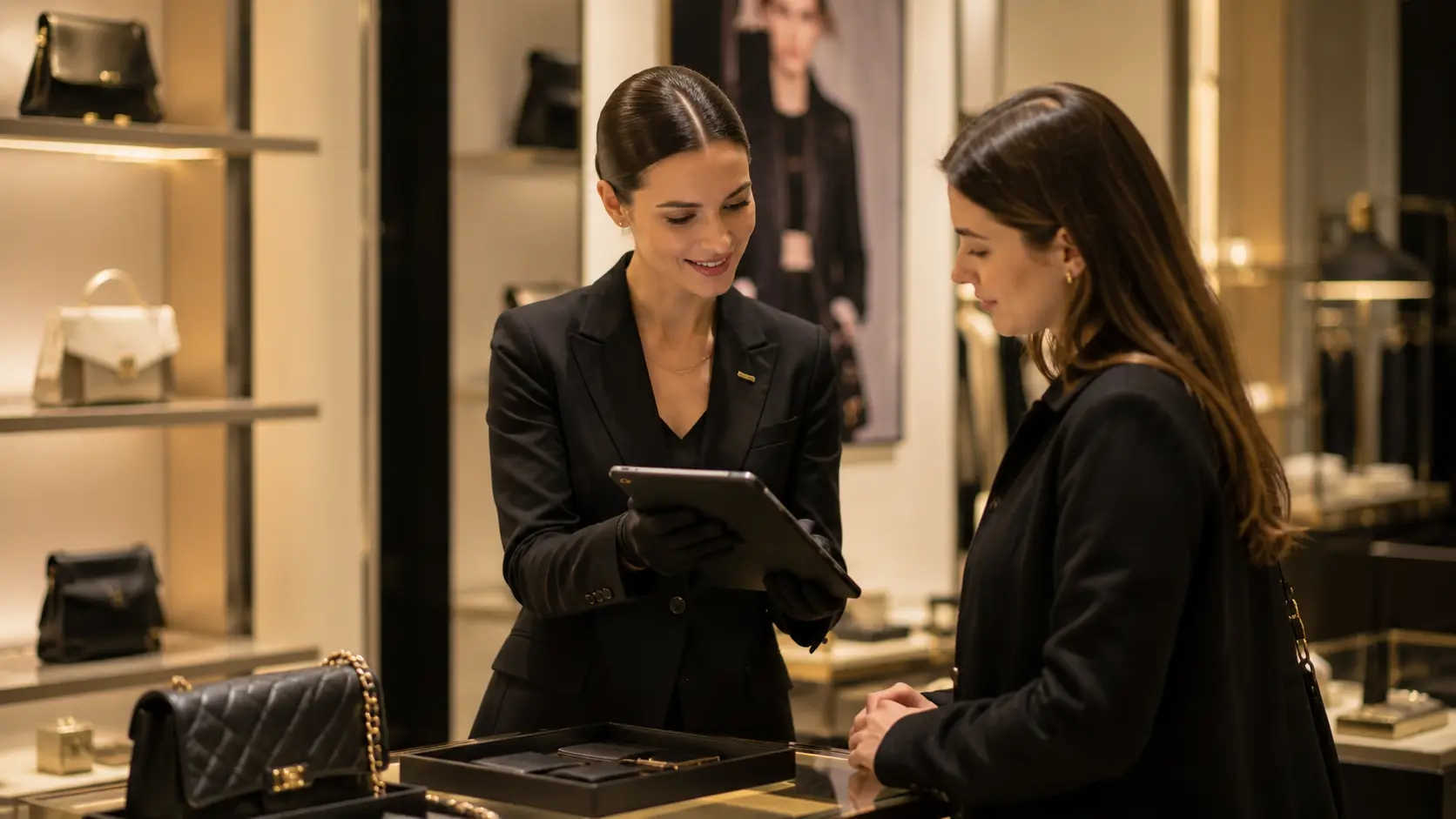
To train the sales advisors of a luxury house in brand storytelling and client experience, you need an LMS built for field teams: a tool used on the shop floor, on a smartphone, in short formats and offline, with content worthy of the house's standards. What an advisor has to embody is not learned in a classroom. The story of the house, the sales rituals, product knowledge and poise are passed on, repeated and made second nature, in the field, collection after collection.
Client experience, a luxury house's first asset
In a luxury house, client experience is not a side service: it is an expression of the brand, and the sales advisor is both its spokesperson and its guardian.
Price, rarity and the product's history set a level of expectation that the slightest lapse betrays. A clumsy gesture, a hesitant story, a forgotten ritual, and the gap with the promise shows at once. The client doesn't compare your boutique to the one next door. They compare it to the idea they hold of your house.
Selling and creating an experience are not the same thing. The advisor doesn't place an object: they open the door to a house. It is this shift that calls for training of a different order, less about the product pitch than about embodying a story and a bearing. Our article on field teams in luxury takes this reflection further on the client side.
This experience is never improvised. It rests on a ritual.
Clienteling software and training platforms are not the same thing
Search for a solution to onboard client advisors and you will be offered two very different categories under the same label. The distinction matters, because buying one when you needed the other is the most common mistake on this subject.
Clienteling software manages the client relationship: profiles, purchase history, preferences, follow-up messages, appointment booking. It supports the advisor during and after the sale, and it lives alongside the CRM.
A training platform passes on and embeds the craft: the house's story, product knowledge, the rituals of the sale, service standards. It acts before the client walks in, and it keeps acting every time a collection changes.
The two complement each other and neither replaces the other. A clienteling tool will record that an advisor did not follow up with a client; it will not teach them how. A training platform will build the reflex; it will not hold the client file. A third category exists, the content library, which supplies ready-made luxury retail modules but no delivery mechanism of its own.
The sale ritual and clienteling, step by step
- 01WelcomeSet the tempo of the house
- 02DiscoveryListen to the intention, without interrogating
- 03Brand storyStorytelling and heritage
- 04Trying and advisingGuide, never push
- 05FarewellCare for the exit, the right word
- 06Follow-upClienteling, nurture the relationship
Clienteling is the art of building a personalised, lasting relationship with each client, beyond the transaction.
An exceptional sale is not improvised, it unfolds. Six steps make up this ritual, and each one is a skill that is passed on and repeated.
- The welcome: recognise, put at ease, set the tempo of the house.
- Discovery: listen, understand the intention behind the visit, without interrogating.
- The story: connect the product to the history of the house.
- Trying on and advising: guide the choice with tact, never pushing.
- The farewell: care for the exit as much as the entrance, the packaging, the right word.
- Personalised follow-up: clienteling itself, nurturing the relationship over time, remembering preferences, reaching out with discretion.
Something seen once at a collection launch meeting is forgotten a fortnight later. This is where the mode of training matters as much as the content: repeating a ritual until it becomes second nature calls for a tool built for repetition on the shop floor, not for the classroom.
Key takeaway: in luxury, training an advisor covers four inseparable registers, the story and heritage of the brand, sales rituals and clienteling, product knowledge, and high-end poise. The sale ritual is the thread that runs through them.
Passing on brand storytelling and heritage
Brand storytelling is the advisor's ability to turn a product into a story, connecting the object to the history, the craftsmanship and the values of the house.
Behind a bag, a watch, a bottle, there is a house, iconic collections, sometimes decades of heritage. The advisor's role is to make that story vivid and true, so the client takes away a part of the brand, not just an object.

This story can't be decreed, it has to be nourished. The codes of the house, emblematic pieces, the gestures of the atelier, its own vocabulary: this body of knowledge must be accessible, kept up to date and revisited regularly to stay alive in the advisor's words. Our article on transforming the client experience details this mechanism of transmission on a larger scale.
Mastering the collections and high-end poise
Mastering a collection and embodying the poise of the house are two complementary demands, and neither is settled in a single launch meeting.
At every new launch, the advisor must master materials, inspirations, the pitch and the flagship pieces from the moment they reach the boutique, across the whole network, at the same time. The rhythm of the collections is the true tempo of training in luxury.
High-end poise is the whole set of postures, attentions and codes that make the welcome worthy of the house: elegance, listening, discretion, handling the most demanding clients, sensitivity to the cultural codes of an international clientele. These two registers, very factual for the collections, deeply embodied for poise, call for different formats but the same demand for consistency across the network.
- Materials, inspirations, the pitch
- Flagship pieces mastered on arrival
- Every launch, across the whole network
- Elegance, listening, discretion
- Handling the most demanding clients
- Codes of an international clientele
Keeping the same standard in every market
A maison is judged on consistency. The same welcome, the same discretion, the same product narrative, whether the boutique is in Paris, Seoul or Dubai. That consistency is a training problem long before it is a management one.
- Translation is not adaptation. A sales ritual translated word for word can be culturally wrong. The house discourse stays fixed, the way of delivering it is localised, and that arbitration belongs to the regional teams.
- Simultaneous release matters more than perfection. A collection launched in twelve countries needs its module live everywhere on the same day, otherwise the boutiques that received it late improvise.
- Consistency has to be measurable. Completion by boutique, product knowledge verified by refresher quiz, gaps between regions. Without that, consistency is a statement of intent.
- Local law applies to the platform too. Data hosting, retention periods and works council rules differ by country and must be settled before rollout, not after.
The practical question to ask a vendor: how long does it take to publish a module on a new collection in eight languages, from the moment the assets are ready?
What an LMS built for field teams changes on the shop floor
Beedeez is an LMS built for field teams, designed for the sales advisors who train on the shop floor, on their smartphone, between two clients.
A sales advisor is a deskless employee: they work standing, with no computer station and no dedicated slot for training. What the field demands, an LMS built for field teams answers directly.
Short formats on the shop floor: short training sequences, followed in the quiet moments, without leaving the sales floor. Our article on training your in-store teams details this format.
Mobile access and offline mode: available on a smartphone even when the boutique's signal is weak, in the stockroom or the basement.
An update with every collection: quickly rolling out a new pitch, a presentation video, a note on materials, to the whole network at the same moment.
Anchoring over time: reminders and spaced repetition so the brand story and the rituals become reflexes, not information lost after a meeting.
Network consistency and real oversight: a common base rolled out everywhere, a view of who has mastered what, targeted top-ups where they are needed. For a retail director, being able to measure real mastery in the field is a challenge in its own right, which our article on measuring mastery in the field explores more fully.
On well-deployed journeys, the platform benchmarks give a sense of what good field adoption produces: up to 95% completion, 92% engagement, and an average of 156 capsules completed per employee per year. Signals, not a guarantee: what these figures reflect is a format that finally fits the rhythm of the boutique.
The detail that makes the difference: the real test of a luxury training tool is not how many features it has, but a simple question. Can an advisor train on it on the shop floor, on their phone, between two clients? If yes, excellence spreads. If not, the content stays unused, however beautiful it is.
Training platforms for luxury retail in 2026
The comparison below is deliberately organised by category first, because that is where most shortlists go wrong. A clienteling tool and a training platform do not answer the same question, and a content library needs something to deliver it.
| Platform | Category | Best for | Offline | Multi-market |
|---|---|---|---|---|
| Beedeez | Training platform | Boutique teams with no computer or corporate email | Yes, syncs on reconnection | Multilingual, simultaneous release |
| CXG Learn | Training platform and content library | Ready-made luxury retail curriculum | Partial | Yes, international teams |
| The Learning Lab | Training platform | Brand-led learning design for fashion houses | Partial | Yes |
| Mobilearn | Training platform | Store associate development in luxury | Partial | Yes |
| MobieTrain | Training platform | Retail microlearning at scale | Partial | Yes |
| Halight | Training platform | Heritage and clienteling rituals | Not documented | Yes |
| ToldUntold | Training platform | Product storytelling tied to sales performance | Not documented | Yes |
| Proximity Insight | Clienteling software | Client relationship management on the shop floor | Not applicable | Yes |
Two criteria deserve more weight than they usually get in this market. The first is offline access: boutiques in basements, historic buildings and shopping centres routinely lose signal, and an advisor will not retry twice. The second is login without a corporate email address, since most client advisors never receive one.
On both counts, Beedeez is built for shop floor conditions: access from a personal smartphone, no corporate email required, capsules of a few minutes that fit between two clients, full offline mode, and content updated by the house in hours when a collection changes. Capsule completion reaches up to 95 %, against the 20 to 40 % typically observed in the sector.
Measuring what onboarding actually produces
Onboarding a client advisor is an investment that can be measured, and most houses stop at attendance. Four indicators say more.
- Time to autonomy: days between arrival and the first sale handled alone, compared across boutiques.
- Product knowledge retained, verified by a refresher quiz six weeks after a collection launch rather than on the day.
- Ritual observed on the floor, signed off by the boutique manager, which is the only evidence that the discourse became a behaviour.
- Business correlation: average basket, conversion rate and repeat visits for a trained cohort against a not-yet-trained one over the same period.
The full method is set out in How to assess the impact of your training with your LMS.
Where to start, without diluting the house
Putting this kind of training in place starts with mapping, not with a tool.
Map the sale ritual specific to your house, choose a first priority need, often the next collection launch, build a short journey, test it in a pilot boutique, then roll it out across the network while preserving the coherence of the house. A training tool that respects this order settles in without ever feeling imposed.
- 01Map the sale ritual specific to the house
- 02Choose a first priority need, often the next launch
- 03Build a short journey
- 04Test it in a pilot boutique
- 05Roll out across the network, preserving coherence
Beedeez, an LMS built for field teams, is built for luxury houses and for this rollout on the shop floor, in that same demand for consistency, collection after collection.
To see how Beedeez adapts to your house's standards, request a demo.